

This faded blue shirt is an old friend – we’ve been together a long time. Like the one Mary Chapin Carpenter sings about it’s
“so old I should replace it, but I’m not about to try.”
We’ve seen some miles together. It’s soft and comfortable and faded which, like Mary’s, makes it perfect for gardening and work in the backyard. Unlike Mary’s shirt, a cat’s never given birth in it, but to be honest, I think finding the mess associated with newborn kittens in a shirt would be the signal for a definite and final end for me.
Before the mend, the hem and cuffs were fraying and there were holes in and around the collar. All of which made it a perfect piece to try out some visible mending techniques. I’ve been a bit inspired to check out the visible mending scene and to have a go at doing some mending myself by Erin Lewis-Fitzgerald’s book Modern Mending.
As I discovered once I began to delve, there are many many other books, websites and resources around slow fashion and visible mending, but Erin’s was one of the first I came across and still, I think, one of the best. It offers a good introduction to concepts, techniques and resources, as well as providing ideas for projects and showcasing some of Erin’s own work. Best of all, Erin’s book is a perfect size to fit in the stack on my desk to jack my laptop to the right height to write!

Modern Mending is a good book, – if like me, you learnt most of your sewing and craft techniques as a child and haven’t really done anything much for years. I learnt to do a lot of things with my grandmother and her friends, and learning as a child has given me a degree of over confidence. I think I know how to do things, but when I come to do them, I can’t quite remember, or I remember incorrectly, or I remember everything except that special magic tip that makes everything sit perfectly and fit well
But not knowing how to do something hasn’t really stopped me, and Erin’s book and the many many tutorials you can find on youtube to do anything you want stepped me through most things. It’s my gardening shirt, so I wan’t fussed about getting it perfect – I just wanted to learn things and try a few techniques.
Things I learnt along the way:
- I should have used one single colour (blue) for hem and cuffs instead of trying to match the little coloured ‘easter egg’ motifs
- it probably would have been better to use the same colour blue throughout, but instead I just used up the thread I had, with a little help from my friend Ruth who gave me some of her surplus which was a slightly different colour

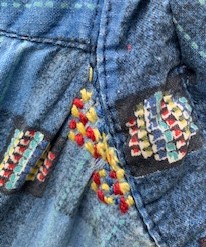
- As I’d made these mends assuming the underside wouldn’t be seen, the messy side then needed to be covered up somehow. The bonus was I’d been wanting to learn Sashiko stitching in preparation for mending a favourite old jean jacket and I got to try it out here. It looks pretty messy because I’m trying to cover the backside of the other mends. I’m not really sure it can be called Sashiko, but the other thing I learned is that it is important to the outcome to follow the rules and do Sashiko as instructed rather than follow a more ‘freeform’ process. An important lesson for me in what not to do before I tackle the jacket – which unlike this shirt, I do want to wear in public!
- I’m not really fussed on the brighter blue colour for the replacement of the underside (or as it actually turned out the ‘right side’ of the collar,) but it was surprisingly difficult to find plain flannelette. I went to a few different shops looking for new material as well as visiting a few op shops in the hope of finding an old shirt that might work, but this was the closest I could get. Not what I hoped, but close enough, and I didn’t want to waste more time searching for a perfect match.
So here it is – my old blue shirt, patched up and with luck, good to go for a couple more decades.
 Cathwrite